A 2024 study found a close planet around Barnard’s Star
ESPRESSO measured a short-period sub-Earth-mass world; later instruments tested the signal and refined which other signals count as planets.
Article link
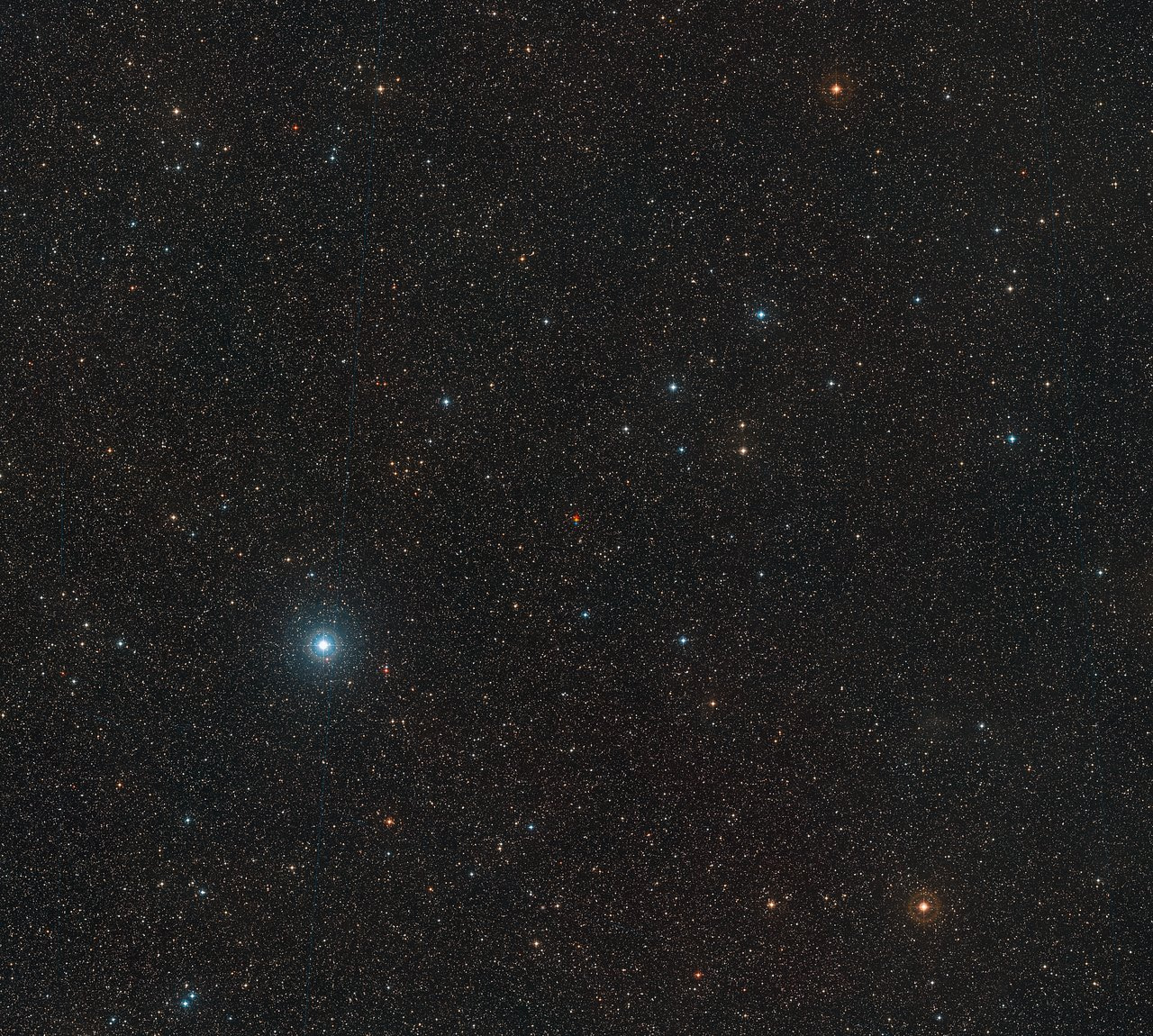
A repeated stellar tug
In 2024, ESPRESSO observations revealed a signal repeating every 3.1533 days. The team analyzed 156 measurements across four years, modeling stellar activity before testing whether a planetary signal remained. Radial velocity detects the star’s back-and-forth motion through spectral shifts, rather than directly imaging the planet.[1]
The fitted orbit has a minimum mass of about 0.37 Earth masses and lies roughly 0.023 astronomical units from the star. “Minimum” matters: the method gives a lower bound that depends on the orbit’s tilt, not a direct radius or density. The paper estimates an equilibrium temperature near 400 kelvin for an assumed albedo of 0.3, a model rather than a surface measurement. The planet is closer to its star than the habitable zone’s inner edge. They reported three other short-period signals as candidates needing more observations.[1]
What the next observations tested
A TESS analysis found no significant dip at the predicted transit times in its Sector 80 light curve. That does not cancel the radial-velocity result: a planet may not cross its star from our viewing angle. The data provide no transit depth to estimate a radius, while the study’s inclination constraint applies only to the light curve it examined.[2]
In 2025, MAROON-X independently recovered b from 112 radial velocities. Its analysis kept signals c and d at candidate status, while a joint fit with ESPRESSO strengthened the case for planet e. The team also found no habitable-zone planet above 0.57 Earth masses at 99 percent detection probability; that limit does not rule out smaller worlds.[3]
Sources & further reading
- A sub-Earth-mass planet orbiting Barnard’s starGonzález Hernández et al. / Astronomy & AstrophysicsPublished October 1, 2024Accessed November 3, 2026
ESPRESSO paper: signal, mass, orbit, temperature, and candidates.
- No evidence of transits in TESS photometryStefanov et al. / arXivPublished October 1, 2024Accessed November 3, 2026
Sector 80 light curve shows no transit detection.
- Four sub-Earth planets from MAROON-X and ESPRESSOBasant et al. / The Astrophysical Journal LettersPublished March 11, 2025Accessed November 3, 2026
Independent velocities separate planets from candidates.
Keep exploring
A 2025 study reported a planet candidate in TWA 7’s debris ring
A JWST source observed in 2024 fits a cool companion, while follow-up supports the interpretation without yet testing shared motion.
Read story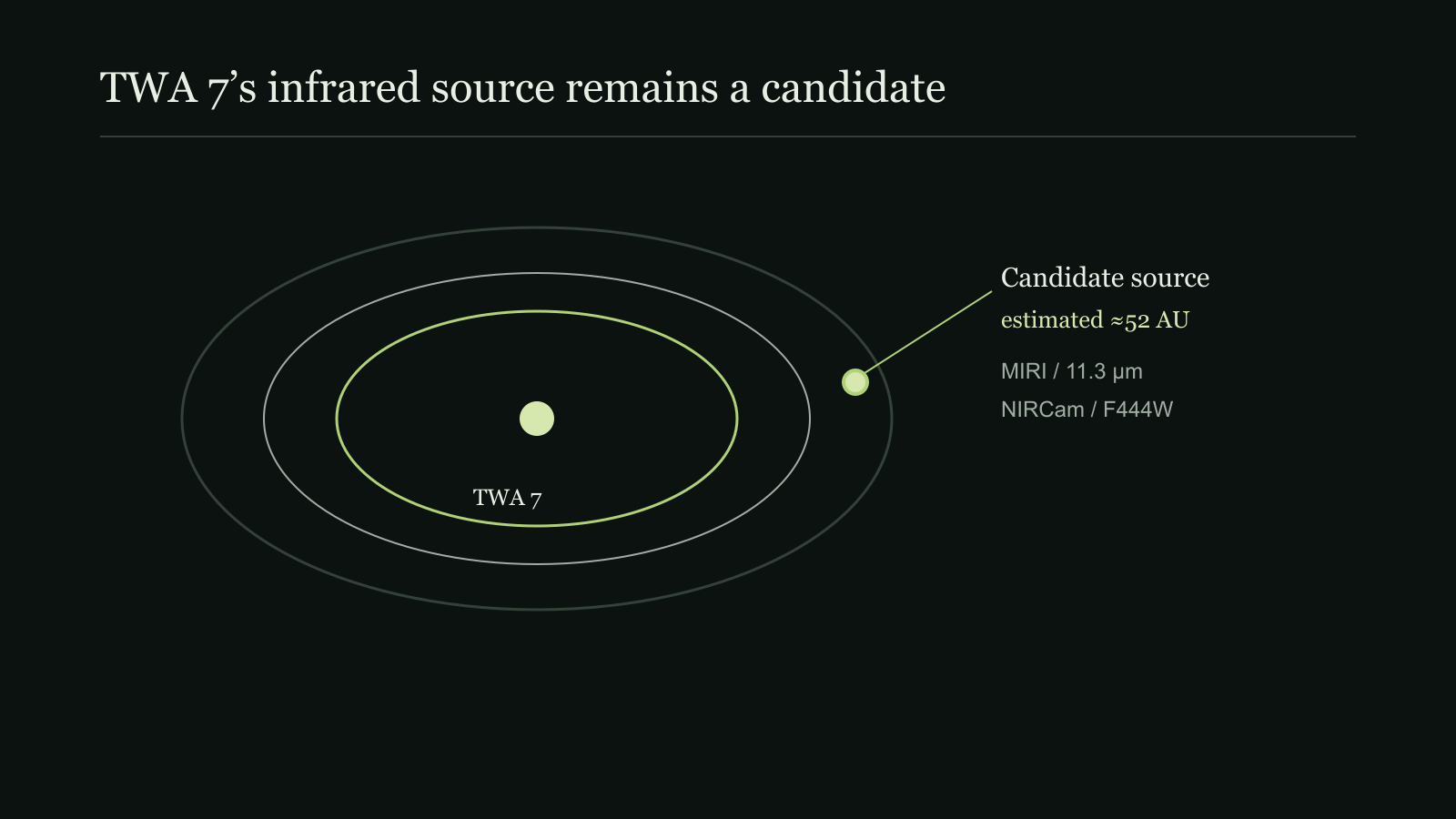
A 2026 CHEOPS highlight: AU Mic c’s transit timing reversed
Timings from 2024 moved AU Mic c back toward its predicted schedule; the size and cause of the variation remain uncertain.
Read story
TOI-4129 b at the Neptune ridge’s inner edge
A preprint reports confirmation of a 3.27-day planet using transits and stellar-wobble measurements.
Read story