A 2025 study reported a planet candidate in TWA 7’s debris ring
A JWST source observed in 2024 fits a cool companion, while follow-up supports the interpretation without yet testing shared motion.
Article link
An infrared point in a ring
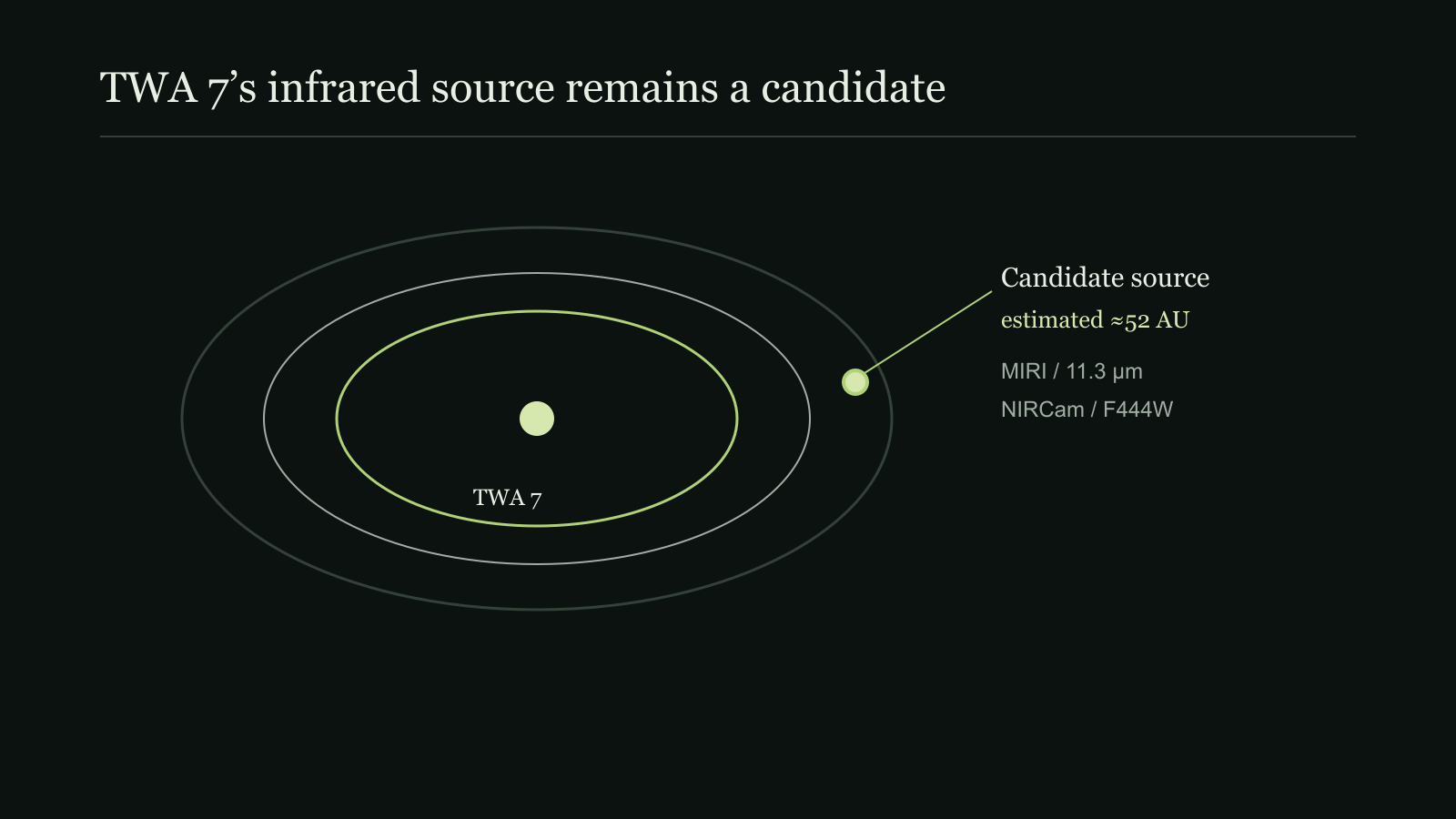
JWST’s MIRI instrument observed the source on 21 June 2024; the Nature study appeared a year later. The faint point lies about 1.5 arcseconds northwest of TWA 7, a roughly 6.4-million-year-old star. Its deprojected distance is about 52 astronomical units, overlapping a narrow ring and a dip in the debris disk.[1]
Atmosphere and cooling models fit a companion near 0.3 Jupiter masses and 305–335 kelvin. These are estimates, not direct measurements. A background galaxy is unlikely but not excluded: the paper estimates about a 0.34 percent chance for a galaxy meeting its specific wavelength constraints within 1.5 arcseconds, with substantial uncertainty.[1]
A second infrared view
A 2025 NIRCam follow-up reported two faint potential sources in F444W at about 2–3 sigma; one sits at the MIRI candidate’s location. The team also imaged the disk in F200W, and found many of its previously seen structures. A repeated position in another filter adds evidence, though an image alone cannot establish that a source is bound to the star.[2]
The MIRI and NIRCam visits were only two weeks apart, too short to test whether the source shares TWA 7’s motion against background objects. The follow-up therefore treats it as a candidate awaiting more characterization. Later dynamical work used the planet interpretation in simulations, but that assumption is not a new image or a motion measurement.[2][3]
Modeling under an assumption
A 2026 dynamics paper asked how the disk could behave if the outer candidate is a planet and whether an additional inner planet could also fit the system. Its results depend on that starting model and add no observation of the outer source. The 2025 imaging case is promising, but orbital association still needs to be tested.[3]
Sources & further reading
- Evidence for a sub-Jovian planet in the young TWA 7 diskLagrange et al. / Nature, full text in PubMed CentralPublished June 25, 2025Accessed November 3, 2026
Nature study: MIRI source, disk location, models, and galaxy estimate.
- TWA 7 planet-disk system follow-up with JWST NIRCamCrotts et al. / arXivPublished June 24, 2025Accessed November 3, 2026
Full manuscript: coincident source and motion-test limitation.
- Dynamics of the TWA 7 planetary systemLacquement et al. / arXivPublished March 3, 2026Accessed November 3, 2026
Model assumes an outer planet; no new imaging epoch.
Keep exploring
A 2024 study found a close planet around Barnard’s Star
ESPRESSO measured a short-period sub-Earth-mass world; later instruments tested the signal and refined which other signals count as planets.
Read story
A 2026 CHEOPS highlight: AU Mic c’s transit timing reversed
Timings from 2024 moved AU Mic c back toward its predicted schedule; the size and cause of the variation remain uncertain.
Read story
TOI-4129 b at the Neptune ridge’s inner edge
A preprint reports confirmation of a 3.27-day planet using transits and stellar-wobble measurements.
Read story