ED138 gains an older record
Preprints add old ground and space observations to Rubin’s dwarf-planet candidate; its diameter remains uncertain.
Article link
The candidate
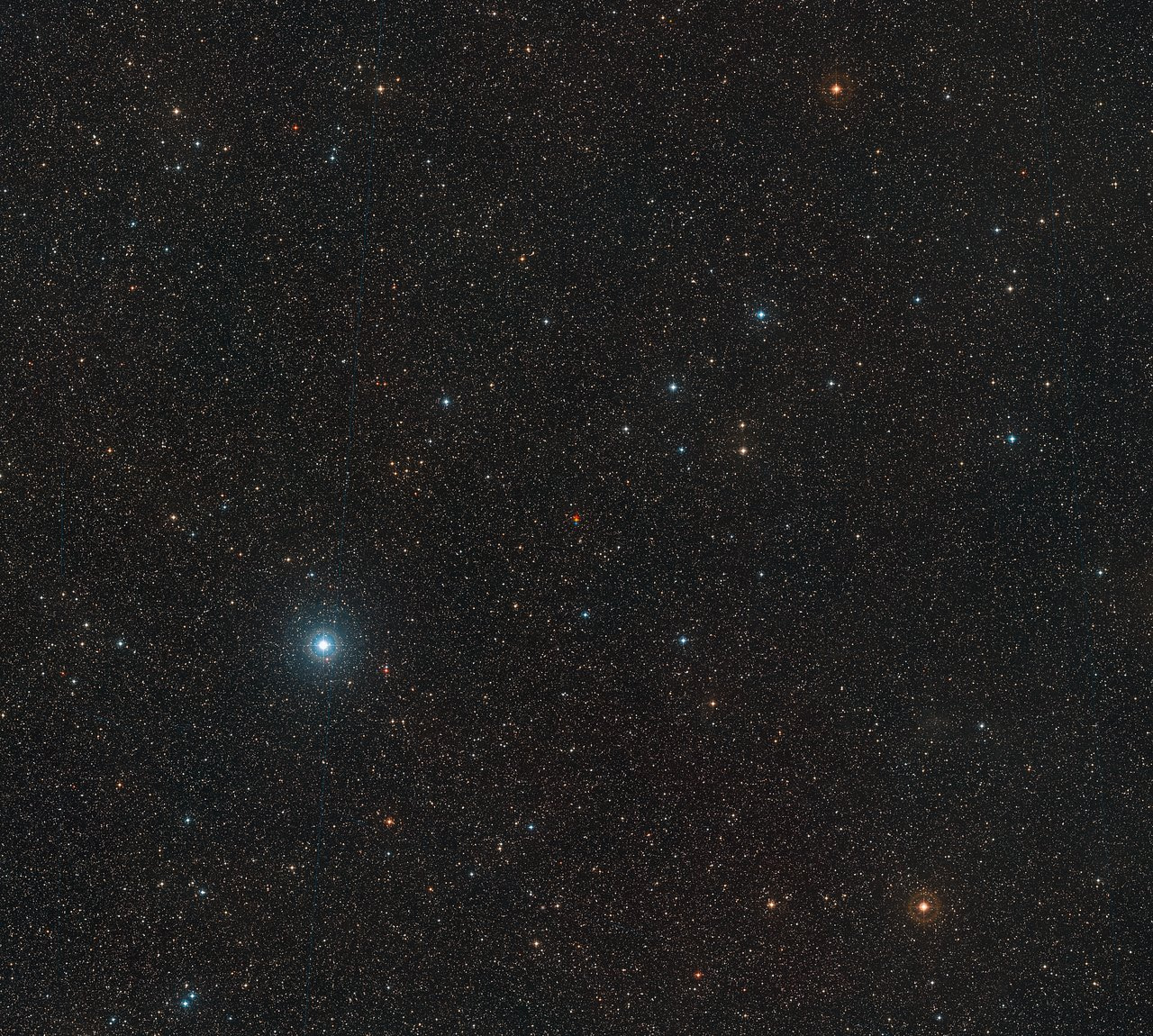
Rubin Observatory announced 2026 ED138 on 27 October as its first dwarf-planet candidate. The trans-Neptunian object lies near the crowded Milky Way plane, where background stars can hide faint moving sources. Rubin says infrared observations are still needed to constrain its diameter and confirm whether it qualifies as a dwarf planet.[1]
Ground precovery
A 28 October arXiv preprint combines Rubin and DECam observations into a 3,789-day arc, spanning 25 February 2016 to 11 July 2026.[2]
A space-based check
A second arXiv preprint, posted 29 October, uses five month-long TESS sectors from 2019 to 2026. The team subtracts Gaia DR3 stars from crowded full-frame images, then stacks frames along ED138’s predicted path so its faint moving signal adds together. It appears in all five sectors, and TESS positions alone agree with the JPL orbit. The study reports 5–21σ detections per sector and 34σ combined.[3]
Size remains conditional
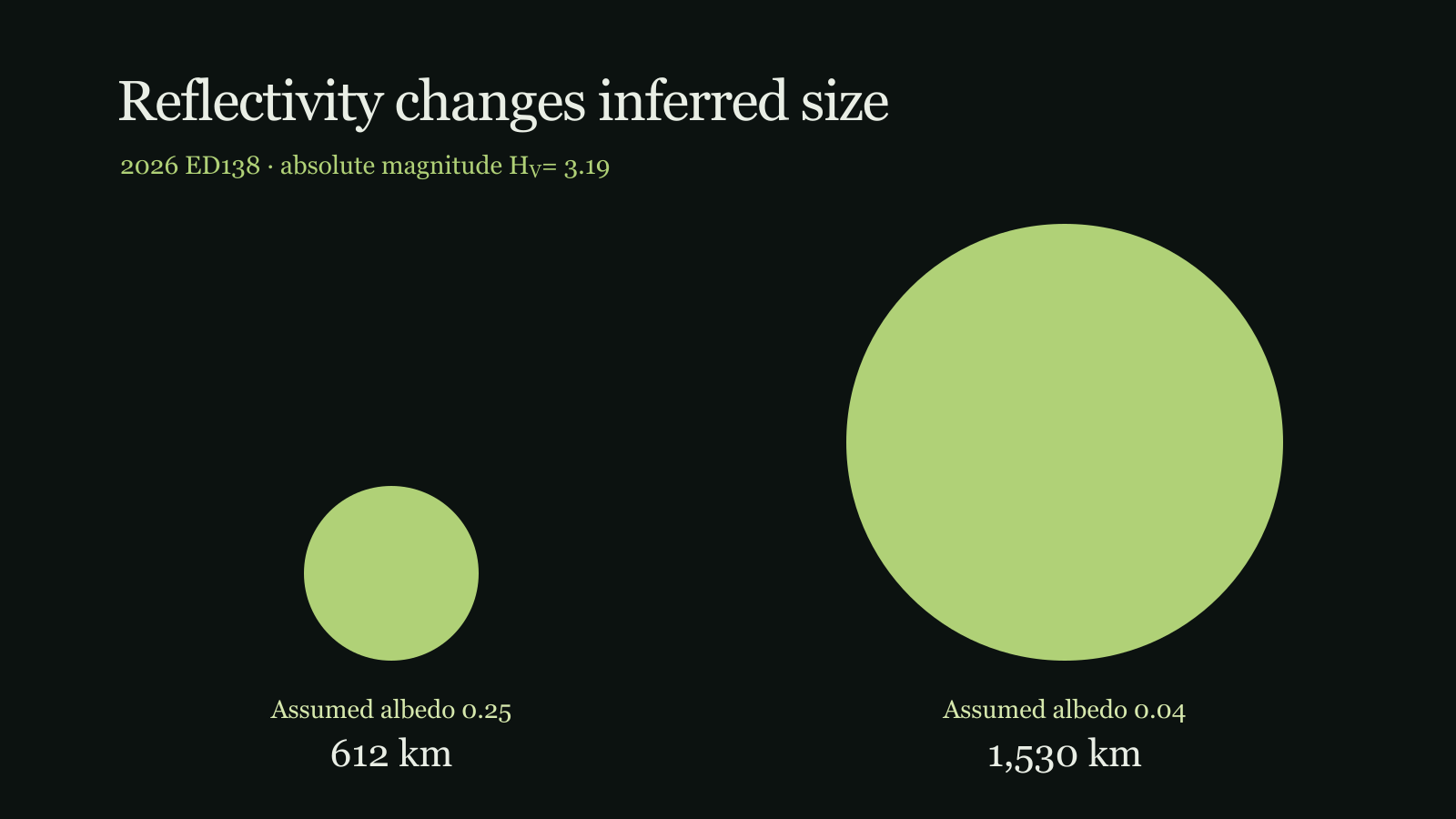
For absolute magnitude H_V=3.19, assumed geometric albedos of 0.25, 0.10 and 0.04 yield conditional diameters of 612, 968 and 1,530 km. These examples are not a measured size range or probability distribution.[2]
Sources & further reading
- NSF–DOE Vera C. Rubin Observatory Reveals Its First Dwarf Planet Candidate in Our Solar SystemNSF–DOE Vera C. Rubin ObservatoryPublished October 27, 2026Accessed November 4, 2026
Candidate designation and follow-up needs.
- 2026 ED138: A Large Trans-Neptunian Object in Early Rubin Observatory Data, and How Many More May RemainarXiv preprintPublished October 28, 2026Accessed November 4, 2026
Observation arc and albedo-dependent size.
- Seven Years of TESS Precovery Observations of the Dwarf-planet Candidate 2026 ED138arXiv preprintPublished October 29, 2026Accessed November 4, 2026
Five-sector detections and orbit check.
Keep exploring
TOI-4129 b at the Neptune ridge’s inner edge
A preprint reports confirmation of a 3.27-day planet using transits and stellar-wobble measurements.
Read story
A 2025 study reported a planet candidate in TWA 7’s debris ring
A JWST source observed in 2024 fits a cool companion, while follow-up supports the interpretation without yet testing shared motion.
Read story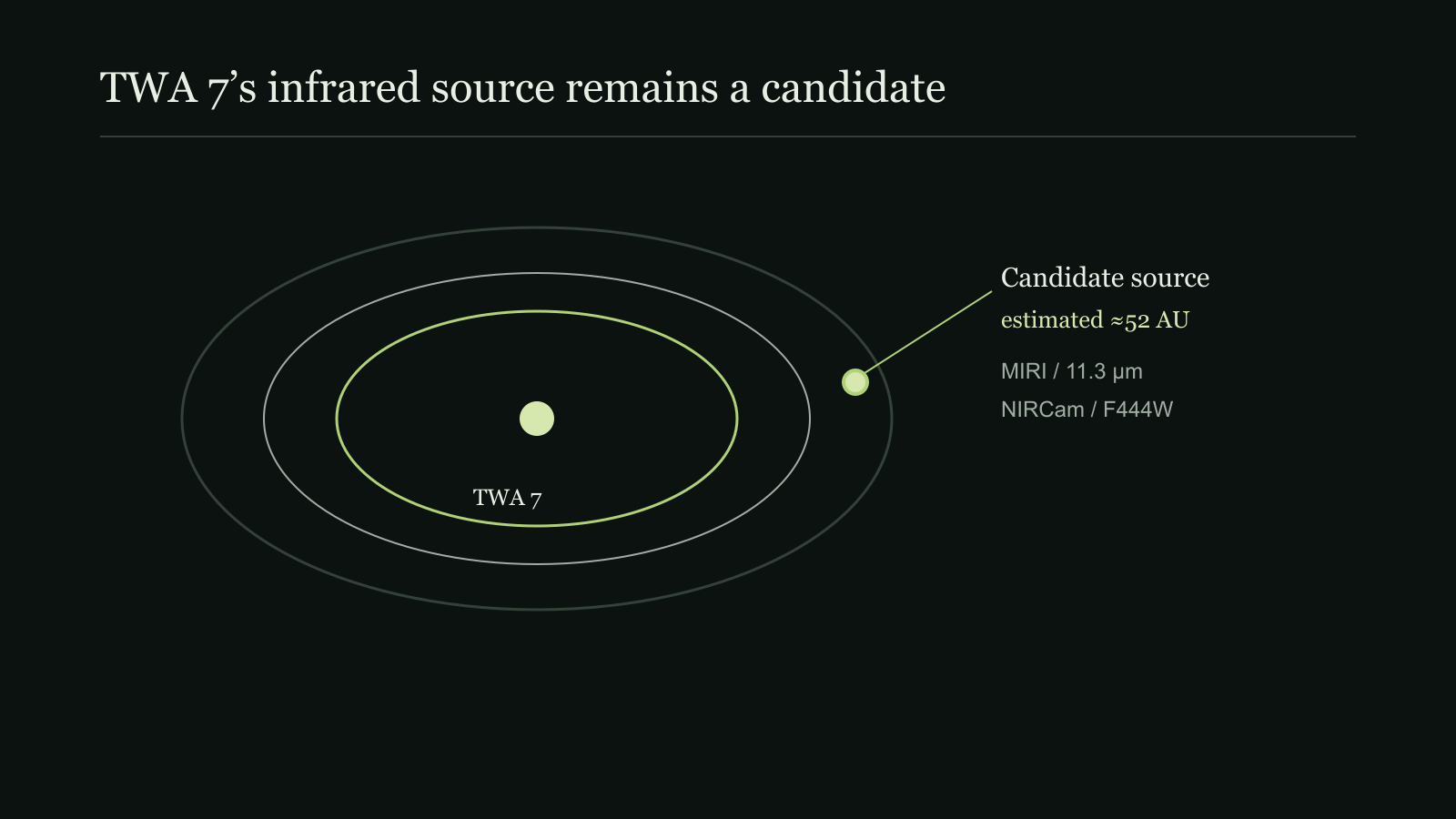
A 2024 study found a close planet around Barnard’s Star
ESPRESSO measured a short-period sub-Earth-mass world; later instruments tested the signal and refined which other signals count as planets.
Read story