Measuring stellar distances with parallax
Parallax links a star’s annual apparent shift to distance; noise and calibration determine confidence.
Article link
A star’s annual shift
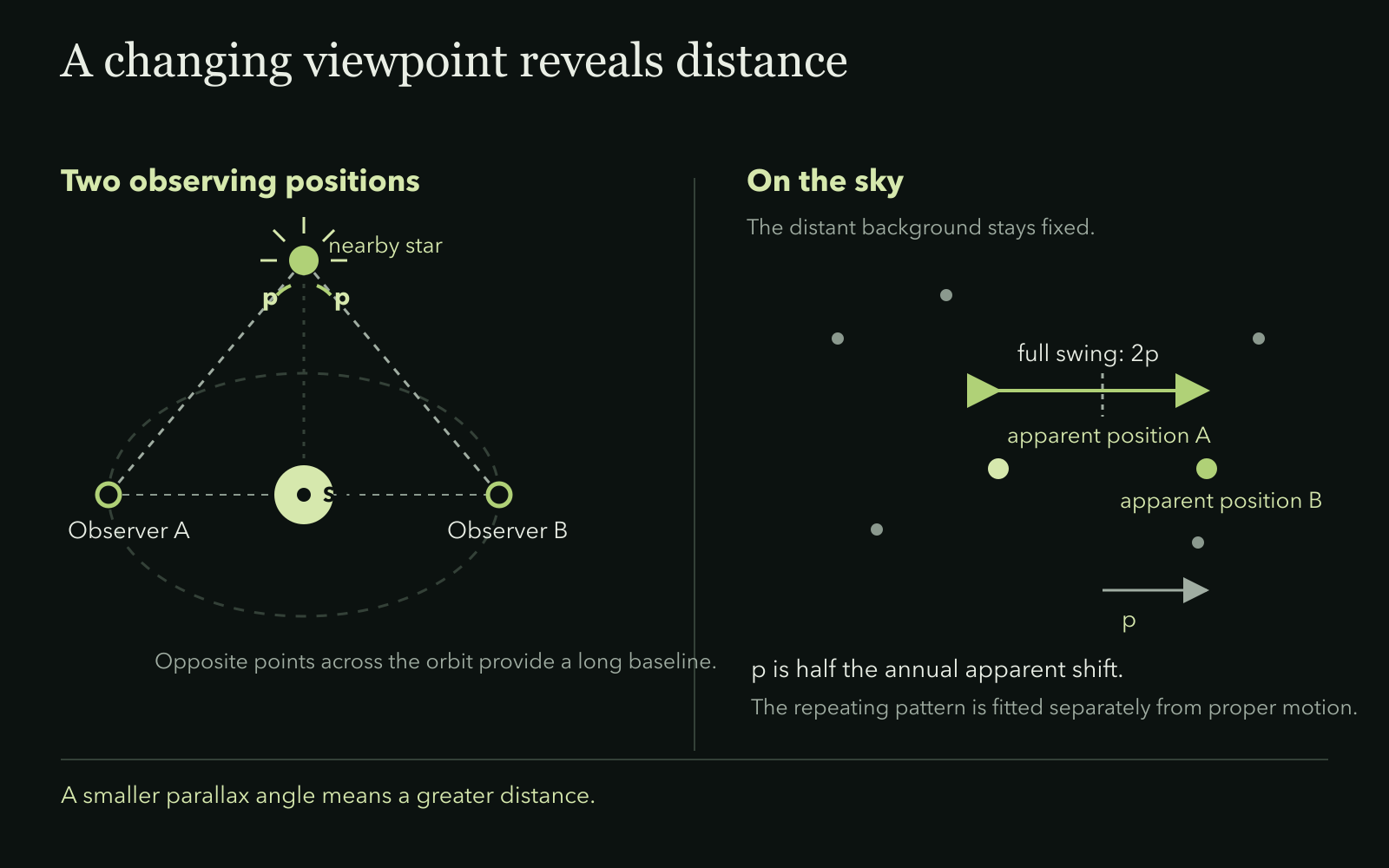
A nearby star appears to shift against distant background stars as an observatory changes position during the year. It is like viewing a finger with one eye and then the other: the closer object seems to move more. Gaia’s changing viewpoint comes from its orbit around the Sun. Astronomers fit the repeating yearly parallax pattern separately from a star’s more gradual motion across the sky.[1]
The parallax angle is half the apparent yearly swing. Measured in arcseconds, it gives distance in parsecs through a simple reciprocal: one arcsecond corresponds to one parsec, while a smaller angle means a greater distance. This is the geometric relationship; actual catalogues report measured angles with uncertainties.[1]
Limits on the distance
As stars get farther away, their parallaxes shrink. If measurement error is a large fraction of the angle, simply taking its reciprocal can produce a misleading distance. A Gaia EDR3 study instead used probabilistic estimates combining parallax and its uncertainty with a model of how stars are distributed in the Galaxy. For a weak measurement, that prior can strongly influence the estimate, so the result should be read with its uncertainty.[3]
Gaia’s EDR3 documentation, dated 3 March 2021, describes an average parallax zero point of about -0.017 milliarcseconds. It varies with brightness, colour and sky position, with additional regional errors and correlations. This figure is specific to EDR3: calibration checks are needed before catalogue measurements become distances.[2]
Sources & further reading
- How does Gaia study the Milky Way?European Space AgencyAccessed November 3, 2026
ESA explains annual parallax geometry and how it is separated from a star’s proper motion.
- Gaia Early Data Release 3 Documentation, release 1.1European Space Agency and Gaia Data Processing and Analysis ConsortiumPublished March 3, 2021Accessed November 3, 2026
EDR3 documentation describes the approximate -0.017 mas zero point and its source-dependent variation.
- Estimating distances from parallaxes. V: Geometric and photogeometric distances to 1.47 billion stars in Gaia Early Data Release 3arXiv; original research published in The Astronomical JournalPublished December 9, 2020Accessed November 3, 2026
Full author manuscript explains why noisy parallaxes need probabilistic distances and how priors influence weak measurements.
Keep exploring
How gravity assists redirect spacecraft
A moving planet can trade a tiny amount of orbital energy when its gravity bends a spacecraft’s path.
Read story
What exoplanet spectra can and cannot show
Transit spectra suggest chemistry, but overlapping signals limit claims about atmospheres and life.
Read story