How gravity assists redirect spacecraft
A moving planet can trade a tiny amount of orbital energy when its gravity bends a spacecraft’s path.
Article link
A turn in one frame changes energy in another
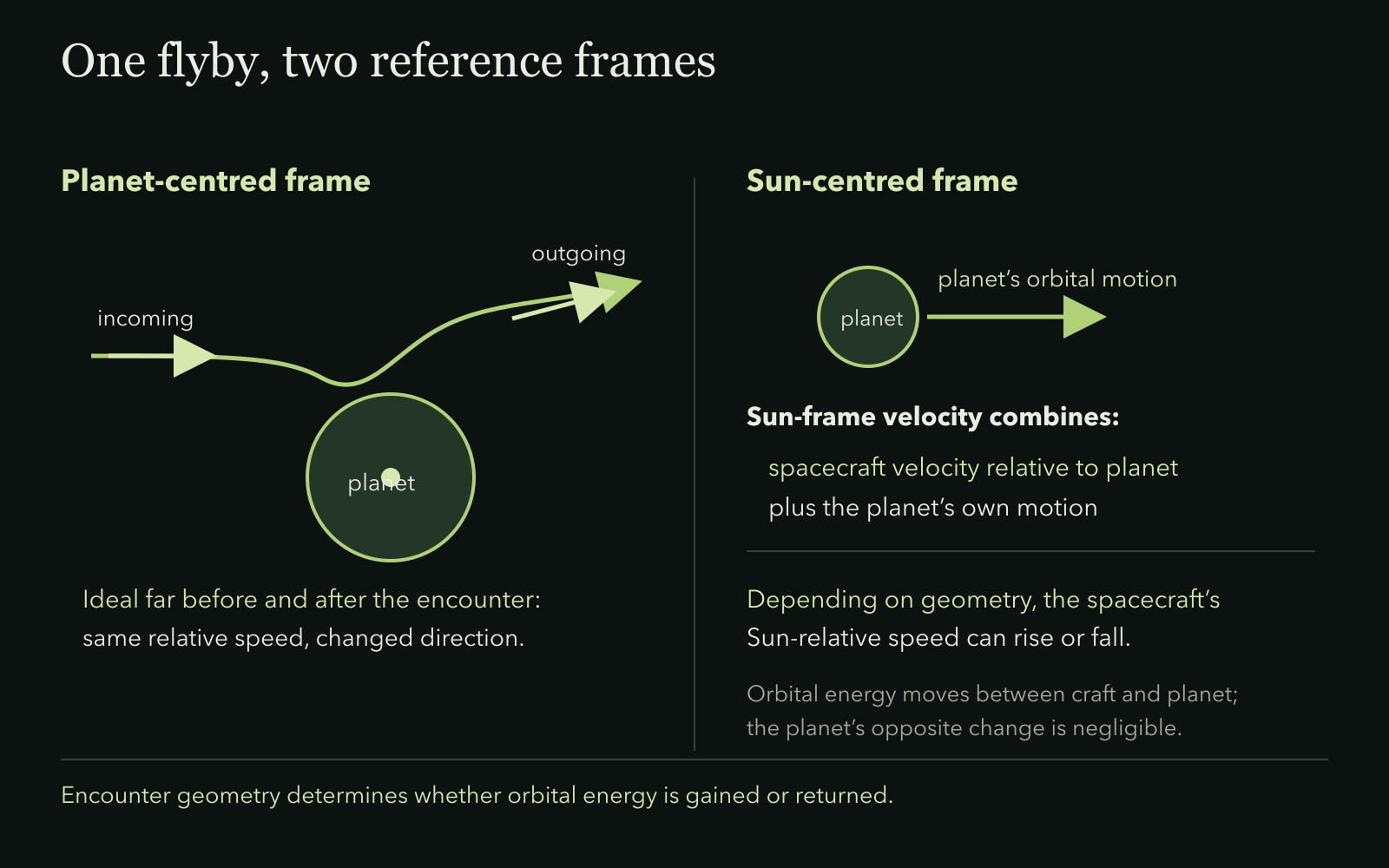
A gravity assist works because a planet is moving. During a close pass, its gravity bends a spacecraft’s trajectory. In an idealised frame moving with the planet, the craft’s speed far before and after the encounter is the same; only its direction changes. That comparison uses the spacecraft’s speed relative to the planet, not its speed measured from the Sun.[1]
Now combine that turned velocity with the planet’s own motion around the Sun. Depending on which side the spacecraft passes and which direction the planet is travelling, the new Sun-relative velocity can be larger or smaller. The craft’s orbital energy changes; conservation of momentum means the planet trades a tiny amount in the opposite sense. This is why “faster” needs a reference frame: a flyby redirects the craft, and the moving planet makes that redirection an energy exchange.[1]
Juice’s 2026 Earth flyby
On 28 September 2026, ESA reported Juice’s Earth flyby deflected its route by 20 degrees and increased velocity by 3.5 kilometres per second. Closest approach was 8,640 kilometres above the Indian Ocean. ESA’s account does not specify the velocity reference frame.[2]
Sources & further reading
- What are gravity assists?European Space AgencyAccessed November 3, 2026
ESA separates planet-centred speed from Sun-centred orbital energy exchange.
- Successful Earth flyby improves Juice’s course to JupiterEuropean Space AgencyPublished September 28, 2026Accessed November 3, 2026
ESA flyby date and reported figures.
Keep exploring
Measuring stellar distances with parallax
Parallax links a star’s annual apparent shift to distance; noise and calibration determine confidence.
Read story
What exoplanet spectra can and cannot show
Transit spectra suggest chemistry, but overlapping signals limit claims about atmospheres and life.
Read story