What TESS’s Neptune ridge actually measures
A population study finds a concentration of planets on short orbits. Understanding its comparison matters as much as the twofold headline.
Article link
A ridge across many worlds
The Neptune ridge is a concentration of planets on roughly three- to six-day orbits, first identified with Kepler. Amadeo Castro-González’s arXiv manuscript finds the population pattern in TESS occurrence estimates.[1]
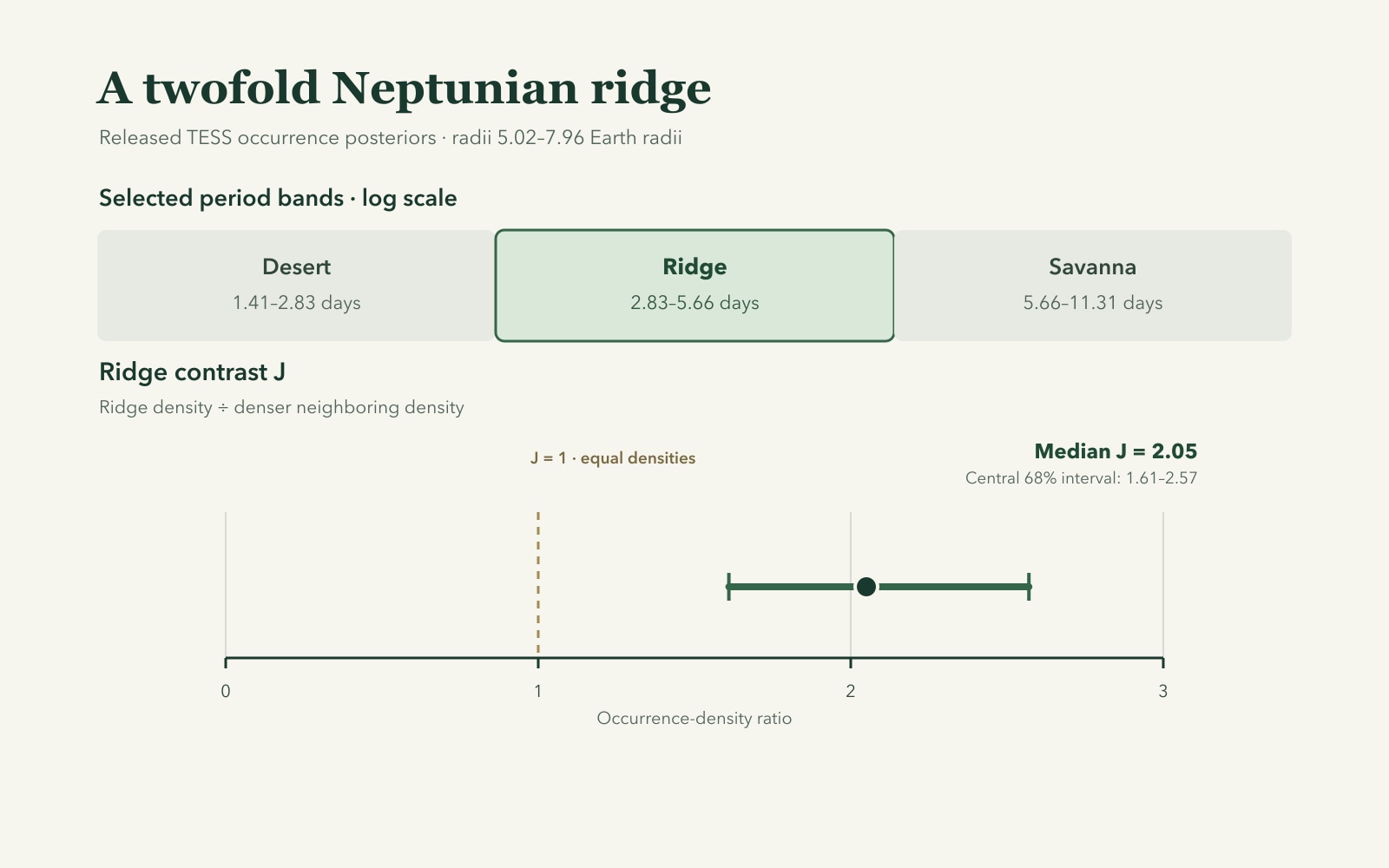
For the tested roughly five- to eight-Earth-radius planets, the ridge’s density is about twice the denser neighbor’s. Models with a peak also outperform a single power law.[1]
Why the denominator matters
The analysis reuses TESS-SPOC estimates corrected for missed planets and unreliable candidates, for F-, G- and K-type main-sequence stars. This is a statistical reanalysis.[2]
Each band’s estimated planets per star is divided by its period width in days, preventing a wider band from gaining an automatic advantage. Comparing the ridge with the denser neighbor then tests whether it exceeds both sides.[2]
The same TESS sample underlies another 2026 analysis; agreement is not another independent population check.[2]
The interval in the graphic describes uncertainty in that population ratio, not variation among individual planets.[2]
The origin remains open
The tested smaller, roughly two- to four-Earth-radius planets show no analogous excess within these period bands. The pattern cannot simply be generalized to every planet size.[1]
Evidence for an asymmetric ridge remains weak. The suggested shape is compatible with migration from highly elongated orbits, but the result does not establish that mechanism. More precise occurrence measurements are needed to resolve the shape.[1]
This explanation uses manuscript version 1, submitted 2 November 2026; journal publication status remains unverified.[1]
Sources & further reading
- The Neptunian ridge through the lens of TESSarXiv recordPublished November 2, 2026Accessed November 5, 2026
Version 1 submission and abstract.
- Full manuscript, version 1arXiv manuscriptPublished November 2, 2026Accessed November 5, 2026
Sections 2–4 and Table 1.
Keep exploring
TOI-4129 b at the Neptune ridge’s inner edge
A preprint reports confirmation of a 3.27-day planet using transits and stellar-wobble measurements.
Read story
More giant companions, or heavier ones?
A census of 719 stars separates how often giant companions occur from how their masses compare with the stars they orbit.
Read story
A 2025 study reported a planet candidate in TWA 7’s debris ring
A JWST source observed in 2024 fits a cool companion, while follow-up supports the interpretation without yet testing shared motion.
Read story