Four spectral peaks point to two rings around a dead star
An unusual light spectrum supports a two-ring model around white dwarf J1328−1450, with alternatives still considered.
Article link
Structure inferred from light
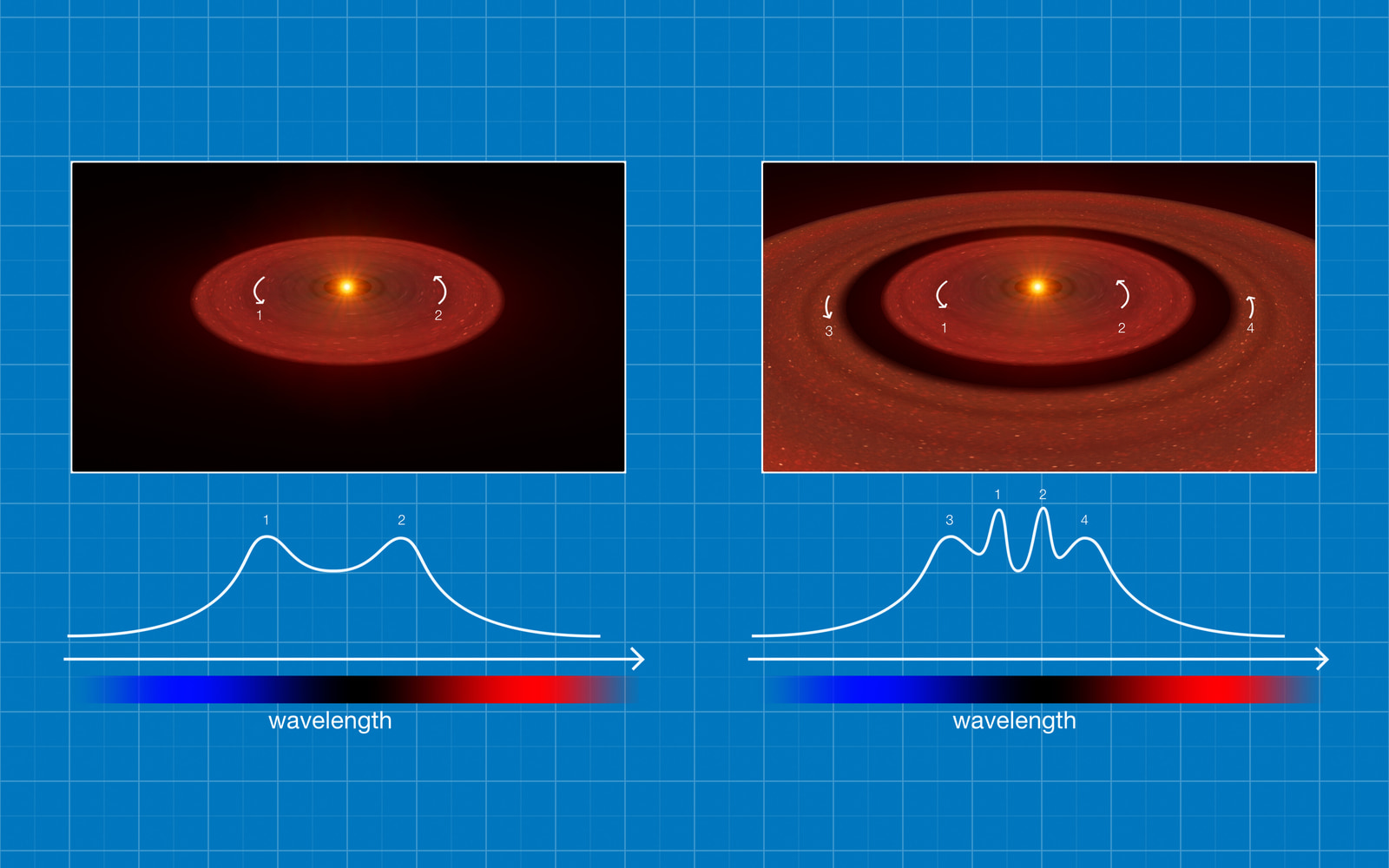
ESO announced the unusual white dwarf J1328−1450 system on 27 October 2026. VLT X-Shooter observations showed four peaks in some gas emission lines, instead of the usual pair in previously known gaseous debris discs around white dwarfs.[1][2]
Gas on opposite sides of a rotating ring moves toward and away from us, shifting its light in opposite directions. Two rings at different speeds can contribute two pairs of peaks. The proposed structure comes from a spectrum, not a photograph resolving two rings.[3]
A model with competing explanations
The paper proposes two surviving solid bodies that feed gas through interactions with dust. Those bodies were not directly measured. It also considers an unresolved pair of white dwarfs with separate discs, judged very unlikely, and a single partly self-shadowed disc. The paper considers self-shadowing as a theoretical explanation, but reports no direct evidence for it or reason it would occur only in this system.[2]
Magnesium is more evident in the inner ring. ESO describes two possible origins for the differing chemistry: different parent bodies, or different layers of one differentiated object. The system helps test how planetary debris evolves after a star dies; it does not establish a specific future for Earth.[1]
Sources & further reading
- Dead star and planetary bodies: astronomers spot unique disc of debris that foretells Solar System’s futureEuropean Southern ObservatoryPublished October 27, 2026Accessed November 3, 2026
Announcement, chemical differences and surviving-body interpretation.
- A double debris disc around a white dwarf sculpted by two planetary bodiesGentile Fusillo and colleagues / Nature AstronomyAccessed November 3, 2026
Full author paper: observations, competing models and limitations.
- Detecting two rings of debris around the white dwarf J1328−1450European Southern ObservatoryPublished October 27, 2026Accessed November 3, 2026
Guide to the pairs of peaks in a rotating gas spectrum.
Keep exploring
Gaia22alz: a proposed trigger for nova winds
A model links Gaia22alz’s wind to its companion but cannot simulate the transition.
Read story
A radio signal traces comet MAPS before its breakup
Radio observations track April gas outbursts; the inferred mass loss depends on modelling assumptions.
Read story
What exoplanet spectra can and cannot show
Transit spectra suggest chemistry, but overlapping signals limit claims about atmospheres and life.
Read story