Gaia BH3: a black hole found by a star’s wobble
The 2024 announcement described a massive dark companion and a tentative clue from its star.
Article link
Gaia’s wobble
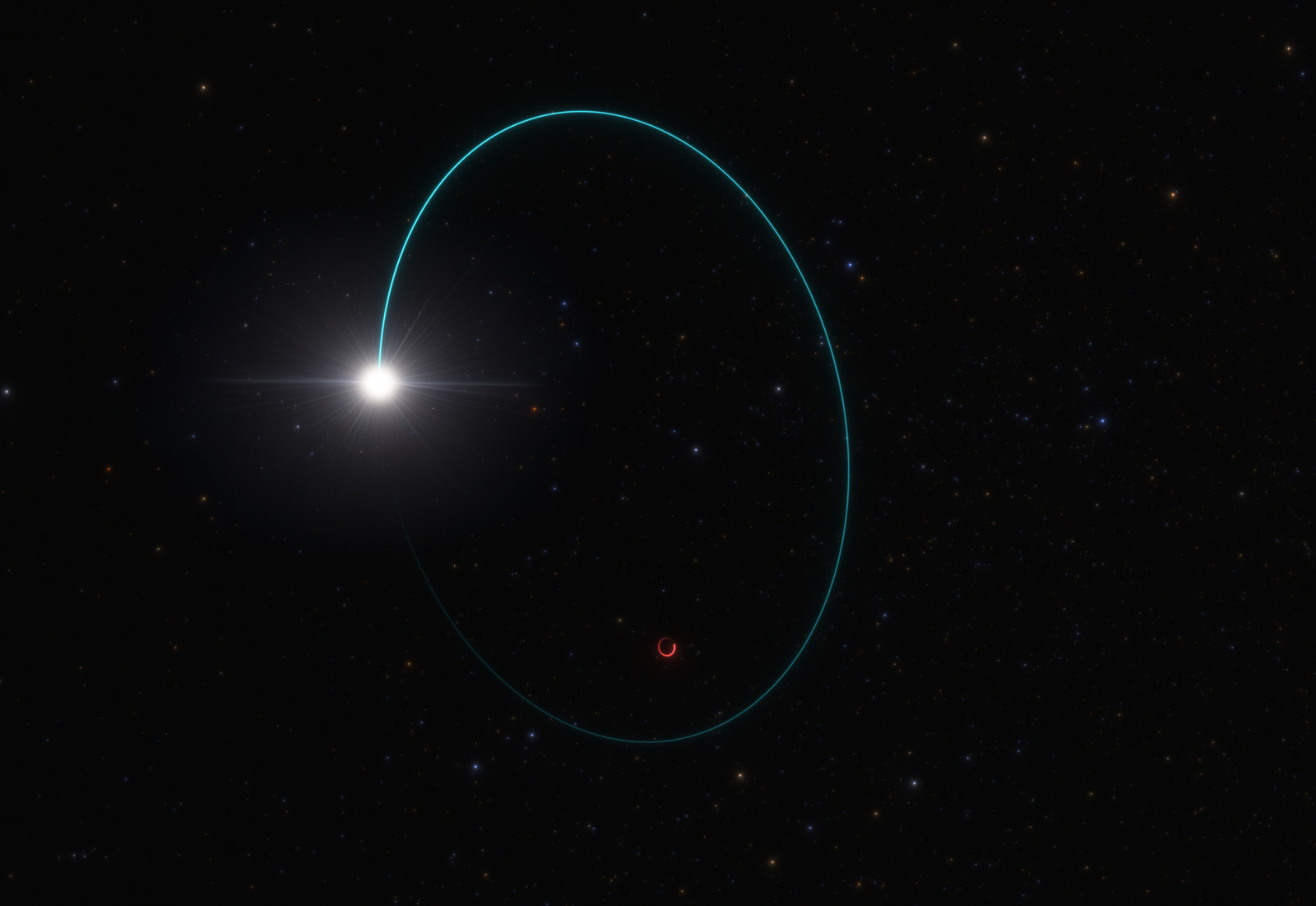
Announced on 16 April 2024, Gaia BH3 had been found while scientists reviewed Gaia observations before a future data release. Gaia tracked a giant star shifting across the sky as an unseen companion tugged at it. ESO described the system as about 2,000 light-years away and, at the time, the Milky Way’s most massive known stellar-origin black hole.[1]
Gaia’s astrometry and spectra showed an 11.6-year orbit and a 32.70 ± 0.82-solar-mass companion at 590 parsecs. Ground-based radial velocities matched the predicted motion within 0.5 kilometres per second. The spectra showed no emission lines, consistent with a dormant black hole.[2]
Mass and limits
One black hole is the simplest interpretation, but the authors could not exclude an inner pair of black holes or a black hole with another compact object. They warn that a small bias in Gaia’s preliminary parallax cannot be quantified, so the mass-function uncertainty may be underestimated. The mass is inferred from motion, not directly imaged.[2]
A metal-poor clue
UVES observations showed that the visible giant has very little iron. Because stars in a pair tend to share chemistry, ESO described this as a clue that the black-hole progenitor was metal-poor. Such stars may lose less mass in stellar winds and leave heavier remnants; the companion is an indirect clue, not a direct measure of the vanished star or proof of one formation path.[1]
This validation discovery is not a population census; Gaia may uncover more quiet binaries.[2]
Sources & further reading
- Most massive stellar black hole in our galaxy foundEuropean Southern ObservatoryPublished April 16, 2024Accessed November 3, 2026
Announcement, companion chemistry and historical mass comparison.
- Discovery of a dormant 33 solar-mass black hole in pre-release Gaia astrometryGaia Collaboration / arXiv author version; Astronomy & AstrophysicsAccessed November 3, 2026
Full primary author version: orbit, mass, parallax uncertainty and alternatives.
Keep exploring
2024 highlight: polarized light maps magnetic clues near the Milky Way’s black hole
A 2024 polarization image revealed a robust spiral pattern, while the surrounding plasma and magnetic field still require interpretation.
Read story
Gaia22alz: a proposed trigger for nova winds
A model links Gaia22alz’s wind to its companion but cannot simulate the transition.
Read story
Ariane 6’s 2024 debut proved the upper stage—and exposed one unfinished test
The July 2024 maiden flight deployed eight passengers after two Vinci burns, but an auxiliary-unit shutdown prevented its planned final burn.
Read story