How laser guide stars help telescopes see sharply
Lasers make sodium beacons that help adaptive-optics systems measure atmospheric blur, while natural stars provide a reference for overall image motion.
Article link
Correcting a moving atmosphere
Earth’s atmosphere is a moving window. Pockets of turbulent air distort the wavefronts of incoming starlight, smearing telescope images. Adaptive optics (AO) measures that changing distortion with a wavefront sensor; a real-time computer tells a deformable mirror how to bend and counter it. The correction is limited to a small patch around the target, so it does not make the entire sky equally sharp.[2][4]
A beacon made of sodium glow
That correction needs a reference beacon. A natural star bright enough and close enough is not available beside every target, so some systems make an artificial guide star: a laser excites sodium atoms high in the atmosphere, and their glow gives the sensor light to measure. The beacon is made in Earth’s air; it is neither a star nor a distant astronomical object.[1][4][2]
What the laser cannot measure
A laser beacon cannot measure every kind of atmospheric motion. Its light travels out and returns through much of the same path, so its apparent position does not reveal the whole image’s tip-tilt shift. ESO’s GRAVITY+ observing guide says the laser measures higher-order distortion, while a natural star is still needed to correct tip-tilt. Laser beacons relax the need for a bright reference star, but they do not remove every natural-star requirement.[4][3]
Why the photo shows streaks
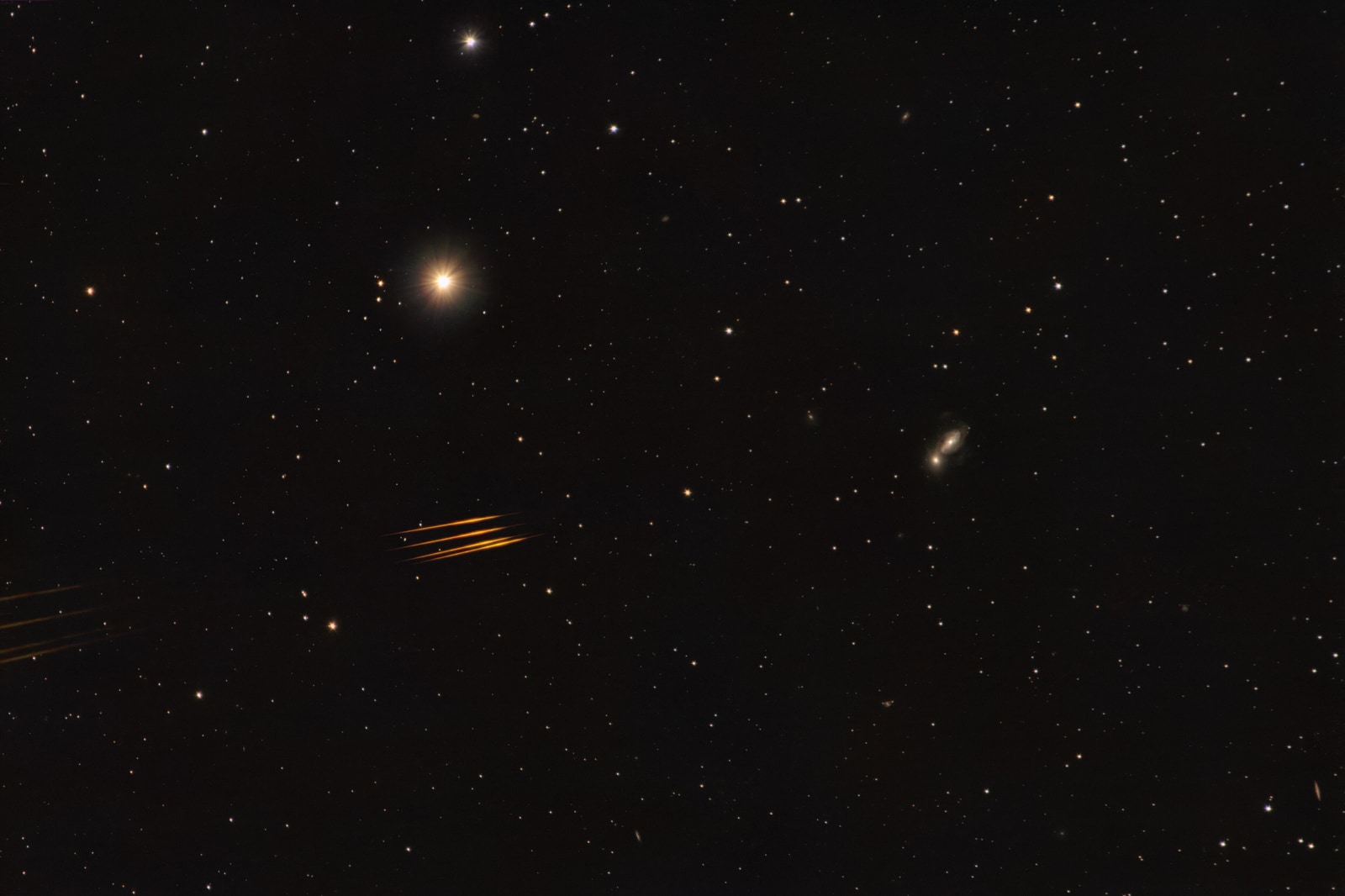
Released 2 November 2026, ESO’s photo shows one beam from each VLT Unit Telescope exciting sodium near 90 kilometres altitude. From a camera 2.5 kilometres away, the 5–10 kilometre-thick glowing layer appears as streaks; from the telescopes it looks point-like. These are atmospheric beacons, not stars.[1]
Sources & further reading
- Stars on demandEuropean Southern ObservatoryPublished November 2, 2026Accessed November 4, 2026
Photograph geometry and sodium glow.
- MAVISEuropean Southern ObservatoryAccessed November 4, 2026
Wavefront sensing and deformable-mirror correction.
- GPAO+LGS Science VerificationEuropean Southern ObservatoryAccessed November 4, 2026
Laser and natural-star roles in GRAVITY+.
- What is Active and Adaptive Optics?European Southern ObservatoryAccessed November 4, 2026
Reference stars and laser tip-tilt limits.
Keep exploring
Gaia22alz: a proposed trigger for nova winds
A model links Gaia22alz’s wind to its companion but cannot simulate the transition.
Read story
SN 2019qem’s modeled 9-solar-mass eruption
The fit places it two years before explosion; wind speed, gas shape and light production affect the estimate.
Read story
JWST measures a redshift beyond 10 for a galaxy candidate
An October 30 arXiv preprint reports CW-LRD-z10’s spectroscopic redshift; its classification and power source remain uncertain.
Read story