Can a planet gap make two CO₂ ice lines?
One simulation predicts paired CO₂ ice lines and a wavelength test for the dust rings they create.
Article link
Where CO₂ freezes
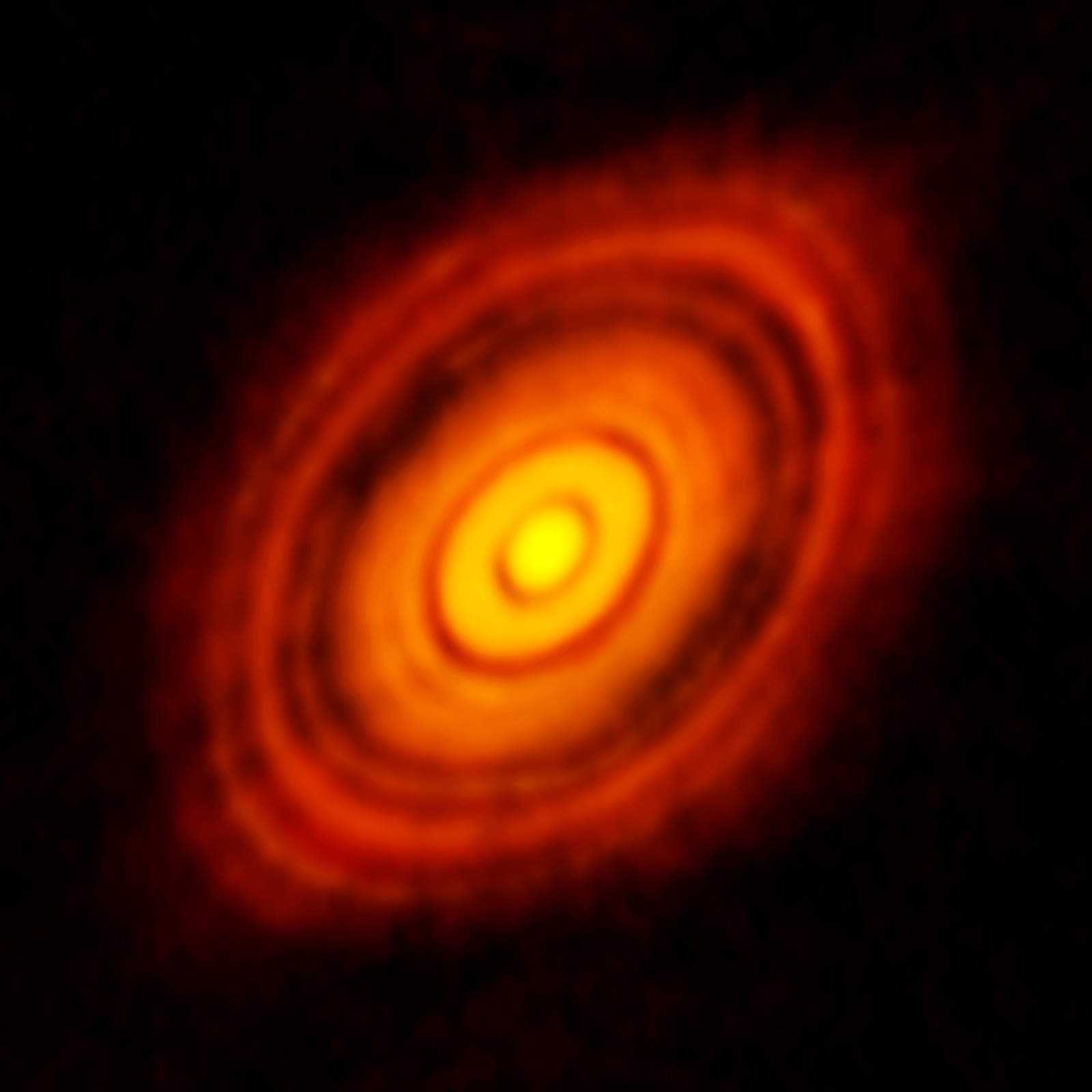
An ice line marks where a substance can freeze onto dust grains in a planet-forming disk. For one substance, a smooth disk usually crosses that temperature once. In the paper’s chosen setup, a planet three times Jupiter’s mass orbits 30 Earth–Sun distances from a star with the Sun’s mass and opens a low-dust gap. With less dust to block starlight, the gap warms: carbon dioxide (CO₂) becomes gas there but stays frozen in cooler disk just inside and outside. The model therefore produces two CO₂ ice lines, one on each side of this particular gap.[2][1]
Why dust gathers
Dust grains collide; they can stick or fragment. The fragmentation speed is the approximate collision speed above which grains tend to break apart. The model assigns water-ice-coated grains inside the hot gap a higher break-up threshold than CO₂-ice-coated grains farther out. This changes modeled grain growth and fragmentation, concentrating dust near both boundaries. The coating-dependent thresholds are assumptions in this simulation; how strong the difference is remains uncertain.[3][2][1]
A test across wavelengths
The paper shows computer-generated views, not telescope observations. Its paired dust rings stand out most in mid-infrared light about five million years into the simulated dust evolution; the millimetre contrast is weaker. In the paper’s comparison model, a pressure trap—a gas-pressure feature that holds drifting dust—makes one ring whose brightest point moves inward at shorter wavelengths. The proposed test is two rings that stay put versus one ring whose peak shifts with wavelength.[1]
In closer-in model cases, the two ice lines sit too near each other for the paper’s cited resolution to separate. Even if paired features exist, a telescope could blur them together.[1]
Model limits
This is one simplified setup, not a result for every disk. The simulation tracks dust along the disk’s radius, averages conditions around the disk, and holds the gas and temperature profiles fixed with the gap already open. Grain properties change abruptly at the ice lines, and the calculation leaves out ice moving between gas and dust as material freezes or evaporates. The authors warn that abrupt transitions may exaggerate ring sharpness; the effect of the omitted ice exchange is not modeled. Finding a pair would be consistent with this explanation, not proof.[1]
Sources & further reading
- Planet-gap-induced ice lines form observable dust rings in protoplanetary disksKan Chen, Tommy Chi Ho Lau and Paola Pinilla / arXivAccessed November 5, 2026
Version 1 was submitted on 2 November 2026. The arXiv record reports acceptance for ApJ; a journal publication date and publisher version of record have not been verified.
- Example: Ice LinesDustPy DocumentationAccessed November 5, 2026
Used for the general meaning of an ice line and uncertainty about coating effects. Its separate demonstration is not the paper’s CO₂ gap model.
- 5. Dust CoagulationDustPy DocumentationAccessed November 5, 2026
Used only for plain-language sticking and fragmentation terminology, not the study’s exact parameter values.
Keep exploring
Uranus’s electron belt: what one flyby can tell us
A Voyager 2 reanalysis and an Earth comparison suggest one possible mechanism, but leave its cause unconfirmed.
Read story
More giant companions, or heavier ones?
A census of 719 stars separates how often giant companions occur from how their masses compare with the stars they orbit.
Read story
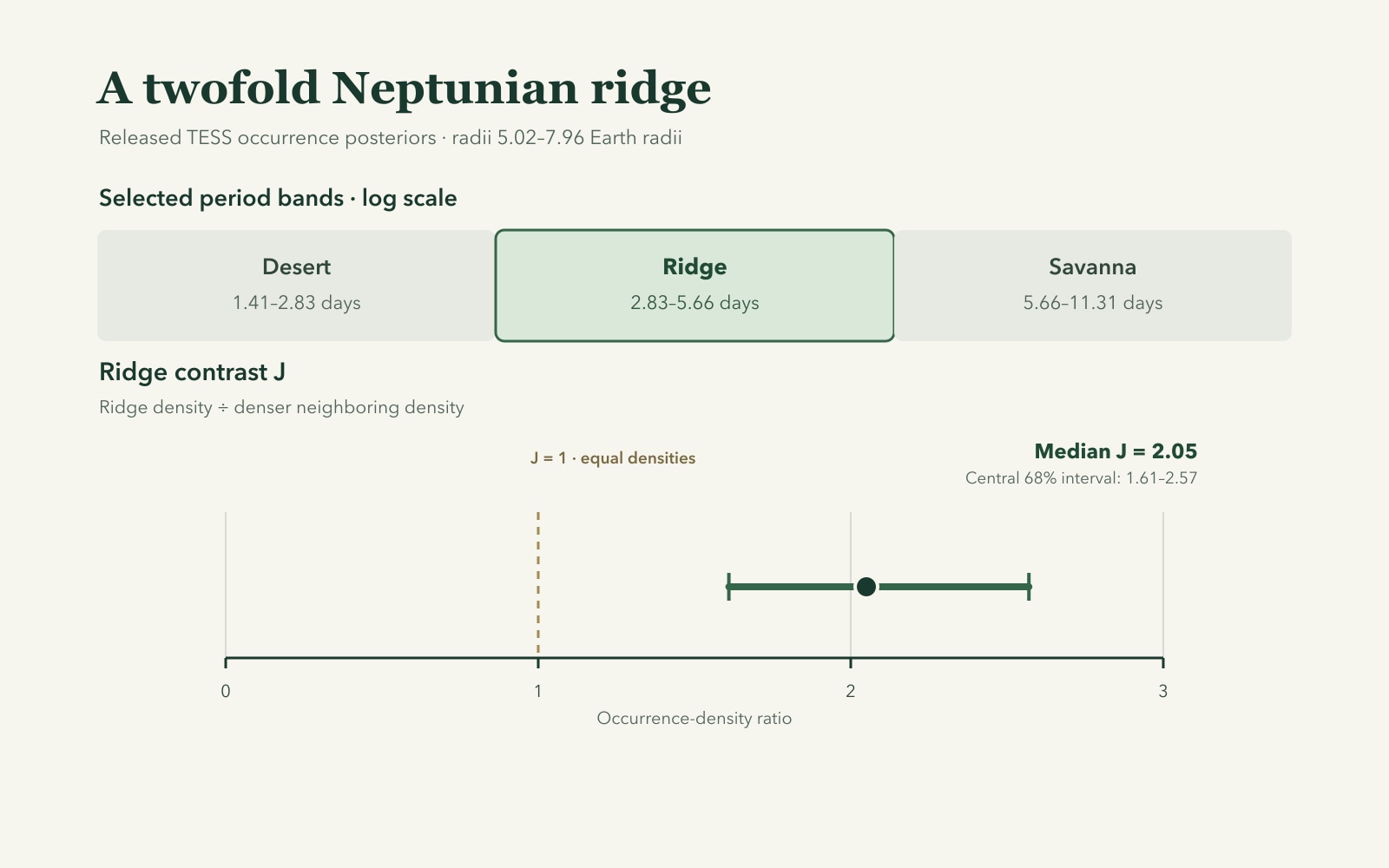
What TESS’s Neptune ridge actually measures
A population study finds a concentration of planets on short orbits. Understanding its comparison matters as much as the twofold headline.
Read story