Uranus’s electron belt: what one flyby can tell us
A Voyager 2 reanalysis and an Earth comparison suggest one possible mechanism, but leave its cause unconfirmed.
Article link
A single Uranus snapshot
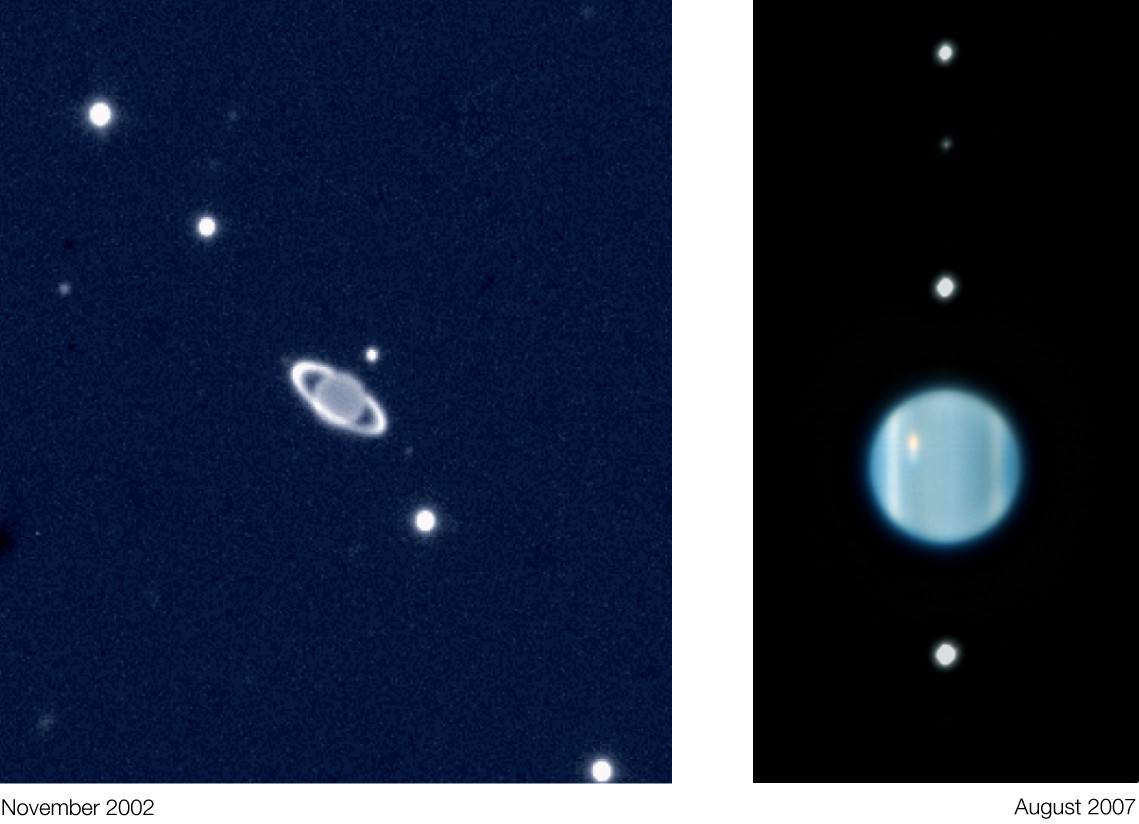
Radiation belts are regions where magnetic fields trap energetic charged particles. Voyager 2’s 1986 flyby remains the only direct snapshot of Uranus’s radiation belts. It found a weaker ion belt alongside a surprisingly intense electron belt. Reanalysis suggests a corotating interaction region (CIR)—a large solar-wind disturbance—may have been passing Uranus at the time.[1][2]
The Earth comparison
The authors compare that pass with a 2019 Earth event measured by Van Allen Probes. Measured fluxes of higher-energy electrons increased alongside lower-band chorus waves, while the proton belt changed little. Chorus is a type of plasma wave in a planet’s magnetic environment. The authors suggest it could transfer energy to electrons. The resemblance motivates a Uranus hypothesis, but does not prove the same process operated there.[2]
Why the mechanism remains tentative
The proposed sequence is a solar-wind disturbance strengthening chorus, followed by electron acceleration. One brief pass cannot establish that timing. Voyager’s Low Energy Charged Particle (LECP) instrument had limited viewing and modified operation, preventing reliable pitch-angle fits—how particle directions line up with the magnetic field. Viewing geometry and sampling therefore complicate its flux readings. The study does not calculate diffusion coefficients needed to estimate wave-driven energy gain at Uranus. The mechanism remains possible, not confirmed.[2]
Sources & further reading
- arXiv record and version historyarXivAccessed November 5, 2026
The record lists version 1 submitted on 1 November 2026, an accepted-manuscript comment and a linked published version with a 2025 Geophysical Research Letters reference. The journal’s exact online publication date and version equivalence have not been verified.
- Solving the Mystery of the Electron Radiation Belt at Uranus: Leveraging Knowledge of Earth’s Radiation Belts in a Re-Examination of Voyager 2 ObservationsarXiv; analysis by R. C. Allen, S. K. Vines and G. C. Ho (Southwest Research Institute)Accessed November 5, 2026
This is the authors’ v1 manuscript, submitted 1 Nov 2026, with a 2025 journal reference on the arXiv record. Its claims are a reanalysis and comparison of historical measurements, not a new Uranus observation.
Keep exploring
Can a planet gap make two CO₂ ice lines?
One simulation predicts paired CO₂ ice lines and a wavelength test for the dust rings they create.
Read story
More giant companions, or heavier ones?
A census of 719 stars separates how often giant companions occur from how their masses compare with the stars they orbit.
Read story
What TESS’s Neptune ridge actually measures
A population study finds a concentration of planets on short orbits. Understanding its comparison matters as much as the twofold headline.
Read story